
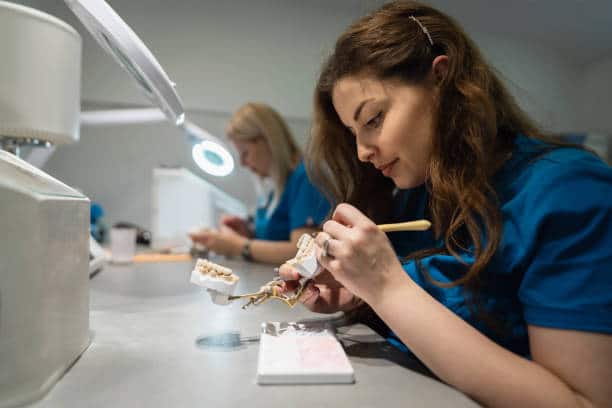
On your first day of training, you might hear terms like “mesial,” “distal,” and “occlusal.” A dentist may mention a “composite,” ask for the “HVE,” or review a “bitewing.” You might also hear shorthand like “prophy” for prophylaxis or “endo” for endodontic. At first, dental conversations can sound like another language.
You don’t need to master dental terminology before you enroll. You learn it step by step during training, and it’s built into Bartram’s 10-week dental assisting program near Jacksonville, FL.
This guide covers the dental terminology for dental assistants you’ll hear most often. Instead of a long alphabetical list, it groups terms the way you’ll use them: anatomy, surfaces, procedures, instruments, radiography, infection control, and more.
Why Dental Terminology Matters for Dental Assistants
Dental terminology is the shared vocabulary of the dental team. It lets everyone describe teeth, procedures, and materials the same way. That team includes:
- Dentists
- Dental assistants
- Dental hygienists
- Front office staff
- Dental laboratories
- Specialists who receive referrals
The same terms appear in treatment plans, lab orders, and referral notes. That consistency keeps everyone working from the same information.
Understanding Instructions During Dental Procedures
Chairside instructions are short and fast. A dentist may name a tooth, a surface, and a material in one sentence. When you know the terms, you can respond quickly and save questions for anything unclear.
Preparing Instruments and Materials Correctly
Every procedure has its own setup. Terms tell you which instruments and materials belong on the tray. A composite filling and an amalgam filling, for example, need different setups.
Understanding Dental Charts and Patient Records
Charts use tooth numbers, surface names, and abbreviations. The whole team relies on these records. Knowing the vocabulary helps you read notes accurately and record findings as the dentist calls them out.
Communicating With Patients and the Dental Team
You’ll use professional terms with the team and plain language with patients. The dentist may say “caries,” while you might tell a patient “a cavity.” Assistants help explain what’s happening, but diagnosis and treatment decisions stay with the dentist.
Basic Dental Anatomy Terms Every Dental Assistant Should Know
Anatomy terms describe the parts of a tooth and where it sits in the mouth. These are the basics you’ll hear most.
Crown, Root, Enamel, Dentin and Pulp
- Crown: The part of the tooth covered by enamel, mostly above the gumline.
- Root: The part below the gumline that anchors the tooth.
- Enamel: The hard outer layer of the crown.
- Dentin: The layer under the enamel that makes up most of the tooth.
- Pulp: The soft center that holds nerves and blood vessels.
For a closer look at tooth structure and why it matters chairside, see our guide to dental anatomy for dental assistants.
Gingiva, Periodontal Ligament, and Alveolar Bone
The gingiva is the gum tissue. The periodontal ligament is a set of fibers that attach the root to the bone. The alveolar bone forms the sockets that hold the teeth.
Maxillary and Mandibular
Maxillary refers to the upper jaw. Mandibular refers to the lower jaw. You’ll often hear these paired with tooth names, such as “maxillary molar” or “mandibular incisor.”
Anterior and Posterior
Anterior means toward the front of the mouth. Posterior means toward the back. Anterior teeth are the incisors and canines, and posterior teeth are the premolars and molars.
Tooth Names and Numbering Terms Used in Dental Assisting
These terms help the team point to one specific tooth.
Incisors, Canines, Premolars and Molars
Incisors are the front cutting teeth. Canines sit at the corners of the mouth. Premolars, also called bicuspids, sit between the canines and molars. Molars are the large back teeth.
In conversation, teeth are often named more precisely. You’ll hear terms like “central incisor,” “lateral incisor,” “first molar,” and “third molar,” which is also called a wisdom tooth.
Primary vs Permanent Dentition
Primary dentition is the set of baby teeth, also called deciduous teeth. Permanent dentition is the set of adult teeth. You’ll also hear “mixed dentition” for the stage when a child has both.
Tooth Numbers and the Universal Numbering System
The Universal Numbering System is the dental numbering system commonly used in U.S. offices. It gives each permanent tooth a number from 1 to 32. Primary teeth use letters A through T.
When a dentist says “#30,” they mean the lower right first molar. Numbers are often paired with surfaces, as in “#30 MO.” You may also see other systems, such as the two-digit FDI system, in some textbooks or international materials.
Quadrants and Dental Arches
The dental arches are the upper and lower rows of teeth, also called the maxillary and mandibular arches. Each arch splits into right and left halves, creating four quadrants. Offices often shorten these to UR, UL, LL, and LR, for upper right, upper left, lower left, and lower right.
Mesial, Distal, Buccal and Occlusal: Understanding Dental Surface Terminology
Surface terms tell the team exactly which side of a tooth needs attention. You’ll hear them in most appointments.
| Dental Term | Plain-English Meaning | Example of Where an Assistant May Encounter It |
| Mesial | Side facing toward the midline of the face | Charting decay between teeth |
| Distal | Side facing away from the midline | Filling notes, such as “DO” |
| Facial | Side facing the lips or cheeks (called labial on front teeth) | Charting front-tooth fillings or chips |
| Buccal | Cheek side of back teeth | Retracting the cheek during a procedure |
| Lingual | Side facing the tongue | Charting and retraction on lower teeth |
| Palatal | Tongue side of upper teeth | Charting upper teeth |
| Occlusal | Chewing surface of back teeth | Sealants and fillings |
| Incisal | Biting edge of front teeth | Chip repairs and bonding |
| Proximal | The mesial or distal surfaces, which face neighboring teeth | Fillings that involve the sides of a tooth |
| Interproximal | The space between two neighboring teeth | Bitewing X-rays and matrix band placement |
Why Dental Assistants Need to Understand Tooth Surfaces
Surface terms appear in charting, radiographs, and restorative procedures. Bitewing X-rays help the dentist check interproximal areas. In charting, surface letters combine to describe a restoration. “MO” means a filling on the mesial and occlusal surfaces, while “MOD” adds the distal surface. Knowing these combinations helps you follow the dentist’s notes and prepare the right setup.
Common Dental Procedure Terms New Assistants Hear
Procedure terms describe the treatment itself. They often combine with the anatomy and surface terms above. For example, a dentist might plan a “composite restoration on #19, MO.” Here are the most common procedure terms by type.
Preventive Dentistry Terms
Preventive dentistry focuses on keeping teeth healthy and stopping problems before they start.
- Prophylaxis (prophy): A professional teeth cleaning.
- Fluoride: A mineral applied to help strengthen enamel.
- Sealant: A thin coating placed in the grooves of back teeth to help prevent decay.
- Examination: The dentist’s evaluation of the teeth, gums, and mouth.
Restorative Dentistry Terms
Restorative dentistry repairs or replaces damaged or missing teeth.
- Caries: The clinical term for tooth decay.
- Restoration: Any treatment that repairs or replaces tooth structure, such as a filling.
- Composite: A tooth-colored filling material.
- Amalgam: A metal filling material, often used on back teeth.
- Crown: A cap that covers the visible part of a damaged tooth.
- Bridge: A fixed restoration that replaces one or more missing teeth.
- Impression: A mold or digital scan that records the shape of the teeth.
- Temporary restoration: A short-term filling or crown worn until the final one is ready.
Endodontic Terms
Endodontics, often shortened to “endo,” is the specialty focused on the inside of the tooth.
- Pulp: In endodontics, treatment focuses on pulp that is damaged or infected.
- Root canal: The channel inside each root. It’s also the common name for root canal treatment, which removes damaged pulp and seals the inside of the tooth.
- Apex: The tip of the root.
Oral Surgery Terms
Oral surgery covers procedures such as tooth removal and treatment of the surrounding tissues.
- Extraction: Removal of a tooth.
- Socket: The space in the bone where the tooth sat.
- Forceps: Instruments that grasp the tooth during removal.
- Elevator: An instrument that helps loosen a tooth before removal.
- Suture: A stitch used to close tissue.
Periodontal Terms
Periodontics focuses on the gums and the structures that support the teeth.
- Gingivitis: Inflammation of the gums.
- Periodontitis: Gum disease that affects the bone and tissues supporting the teeth.
- Periodontal pocket: A deepened space between the gum and the tooth. Pocket depths are measured with a probe and recorded during periodontal charting.
- Scaling: Removal of plaque and calculus, also called tartar, from tooth surfaces.
- Root planing: Smoothing root surfaces below the gumline. It’s often paired with scaling and called “scaling and root planing.”
Orthodontic Terms
Orthodontics focuses on straightening teeth and correcting the bite.
- Malocclusion: A bite where the teeth don’t line up as they should.
- Bracket: A small attachment bonded to a tooth to hold the wire.
- Archwire: The wire that runs through the brackets and guides tooth movement.
- Ligature: An elastic or wire tie that holds the archwire in the bracket.
- Aligner: A clear, removable tray that moves teeth gradually.
Dental Instrument Terminology Every Student Encounters
Many procedure terms connect to specific instruments. Instrument names are part of your daily vocabulary, and these are common ones you’ll hear early in training:
- Mouth mirror: A small mirror for viewing hard-to-see areas, reflecting light, and moving tissue aside.
- Explorer: A thin, pointed instrument for checking tooth surfaces.
- Cotton pliers: Tweezer-like pliers for placing and removing small items.
- Excavator: A spoon-shaped instrument for removing decay.
- Scaler: An instrument for removing calculus, mostly above the gumline.
- Curette: A scaler-like instrument with a rounded tip, often used below the gumline.
- Forceps and elevator: The extraction instruments described above.
- Handpiece: The dental drill that holds and spins a bur. You’ll hear “high-speed” and “slow-speed” handpieces.
- Bur: The rotating tip that cuts or shapes tooth structure.
Why Knowing an Instrument’s Name Is Different From Knowing How to Use It
Instrument knowledge has three levels. Terminology means knowing the word. Identification means recognizing the instrument on a tray. Clinical skill means handling it safely at the right moment. Training builds all three, and clinical skill usually takes the most practice.
Chairside Dental Assisting Terms: HVE, Instrument Transfer and Four-Handed Dentistry
Chairside terms describe how the dentist and assistant work together during treatment. You’ll hear them from your first days in the operatory.
Four-Handed Dentistry
Four-handed dentistry describes how the dentist and assistant coordinate care within an organized treatment area. The name refers to the four hands involved: two from the dentist and two from the assistant.
HVE and Saliva Ejector
HVE stands for high-volume evacuation. It’s a wide suction tip the assistant holds to remove water and debris quickly. A saliva ejector is a smaller, low-volume suction. It removes saliva and can rest in the patient’s mouth. Some procedures use both at once.
Instrument Transfer
Instrument transfer is the exchange of instruments between the dentist and assistant during a procedure. The goal is a smooth, safe handoff that doesn’t interrupt the dentist’s work.
Operator, Assistant Zone and Transfer Zone
The operator is the person performing the procedure, usually the dentist. The operator’s zone and the assistant’s zone describe where each person sits and works. The transfer zone is the area below the patient’s chin where instruments pass between them. These zones are often described using clock positions around the patient’s head.
Dental Radiography Terms New Dental Assistants Should Recognize
Radiography terms describe the types of dental images and the equipment used to take them.
Radiograph vs X-Ray
An X-ray is the form of energy used to create the image. A radiograph is the resulting radiographic image. In everyday office talk, people often use “X-ray” for both.
Intraoral vs Extraoral Images
Intraoral images are taken with a sensor or film placed inside the mouth. Extraoral images are taken with the receptor outside the mouth. Panoramic and cephalometric images are common extraoral examples.
Bitewing and Periapical Radiographs
A bitewing shows the crowns of the upper and lower back teeth together. The name comes from the tab the patient bites on. It helps the dentist check for decay between teeth.
A periapical shows a whole tooth, from the crown to the root tip. “Peri” means around, and “apical” refers to the root apex. A full-mouth series, or FMX, typically combines bitewings and periapicals.
Panoramic Radiography
A panoramic image shows both jaws and all the teeth in one wide view. It’s an extraoral image, and offices often call it a “pano.”
Sensor and Positioning Terminology
A sensor is the digital receptor that captures the image. Some offices use phosphor plates or film instead. Positioning refers to placing the receptor and aligning the X-ray unit correctly. Holders help keep the receptor in the right spot.
Students don’t simply memorize these terms. Radiography training connects them to equipment, positioning, and daily workflow. At Bartram, radiology is part of the curriculum, and the program includes Florida Dental Radiography Certification.
Infection Control and Dental Safety Terminology
Infection control terms describe how dental teams protect patients and staff. You’ll use them every day.
Sterilization vs Disinfection
Sterilization destroys all microorganisms, including bacterial spores. Dental offices usually sterilize reusable instruments with heat, often in a machine called an autoclave. This is part of instrument processing between patients.
Disinfection kills most germs but not all. It’s mainly used on surfaces and equipment, such as light handles and countertops. In both cases, items must be cleaned first. For more detail, see infection control guidance from the American Dental Association.
Cross-Contamination
Cross-contamination is the spread of germs from one person, surface, or item to another. Changing gloves between patients, using surface barriers, and cleaning hands help prevent it.
Standard Precautions
Standard precautions are safety practices used with every patient. They treat blood and most body fluids as potentially infectious, whether or not a patient seems sick.
PPE
PPE stands for personal protective equipment. In dental offices, it includes gloves, masks, protective eyewear, and protective clothing.
Sharps and Biohazard Terminology
Sharps are items that can cut or puncture skin, such as needles and scalpel blades. They go into special sharps containers. Biohazard waste is material that may contain blood or other infectious agents. It’s marked with the biohazard symbol and disposed of separately.
OSHA and HIPAA
OSHA is the Occupational Safety and Health Administration. It sets workplace safety rules, including rules on bloodborne pathogens. HIPAA is the Health Insurance Portability and Accountability Act, which protects patients’ health information. Bartram’s program includes required OSHA and HIPAA training.
Dental Materials Terminology Assistants Encounter During Training
Materials terms describe what dental teams use to restore, protect, or record the teeth. Many appear in Bartram’s week-by-week curriculum. Composite and amalgam come up in Week 4, while luting agents, cements, and impressions come up in Week 6.
Composite and Amalgam
Composite comes in different shades to match the natural tooth color, and it’s often placed in layers. Amalgam is mixed in a machine called an amalgamator, a process known as trituration.
Etch, Bond, and Cure
These steps often happen in order during a composite filling. Etch prepares the tooth surface with an acid gel. Bond is an adhesive that helps the filling attach. Cure means hardening the material, usually with a curing light. Assistants often prepare these materials and pass them to the dentist at each step.
Liner and Base
A liner is a thin layer placed in a deep preparation to help protect the pulp. A base is a thicker layer that adds insulation or support under a restoration.
Dental Cement and Luting Agent
Dental cement holds restorations such as crowns and bridges in place. A luting agent is a type of cement used to seal a restoration to the tooth. You’ll hear the terms “temporary cement” and “permanent cement,” depending on the restoration.
Impression Material and Bite Registration
Impression material captures the shape of the teeth and gums. Alginate is common for preliminary impressions, and assistants often mix it and load the tray. PVS, or polyvinyl siloxane, is often used for final impressions. A bite registration records how the upper and lower teeth fit together.
Common Dental Abbreviations New Dental Assistants May Encounter
Common dental abbreviations include HVE, PPE, FMX, PA, BW, and RCT. You’ll see them in charts, schedules, and chairside conversation.
| Abbreviation | Meaning | Context |
| HVE | High-volume evacuation | Chairside assisting |
| PPE | Personal protective equipment | Infection control |
| OSHA | Occupational Safety and Health Administration | Workplace safety |
| HIPAA | Health Insurance Portability and Accountability Act | Patient privacy |
| FMX | Full-mouth series | Radiography |
| PA | Periapical | Radiography |
| BW | Bitewing | Radiography |
| RCT | Root canal treatment | Endodontics |
| MOD | Mesial-occlusal-distal | Charting a three-surface filling |
Keep in mind that shorthand varies by office. Each practice may use its own abbreviations, and you’ll learn the system where you train and work.
How Dental Terminology Changes Across Dental Specialties
Each specialty adds its own vocabulary. General dentists often refer patients to specialists, so you’ll hear these terms in referral notes too.
General Dentistry
General offices use preventive and restorative terms most. Think cleanings, fillings, sealants, and crowns. You’ll also hear “recall,” which means a patient’s routine return visit.
Orthodontics
Orthodontic teams talk about brackets, wires, aligners, and occlusion (how the teeth meet). A retainer is the appliance that holds teeth in place after treatment.
Endodontics
Endodontic teams focus on the pulp, root canals, and the root apex. You’ll hear about files, which are thin instruments used to clean the canals. A dental dam is a thin sheet that isolates the tooth during treatment.
Periodontics
Periodontal offices discuss gingiva, pocket depths, scaling, and root planing. You’ll also hear “probing depths,” the measurements taken around each tooth. “Recession” refers to gums that have pulled back from the tooth.
Oral Surgery
Oral surgery vocabulary centers on extractions, sockets, and sutures. An impacted tooth is one that hasn’t fully come in, such as a trapped wisdom tooth. “Dry socket” is a painful condition that can develop after an extraction.
Pediatric Dentistry
Pediatric teams work with primary and mixed dentition. They also use lettered tooth identification. A space maintainer is an appliance that holds space open after a baby tooth is lost early.
You don’t need specialist-level knowledge of every term in your first week. Your vocabulary grows as your training and clinical exposure grow.
How Dental Assisting Students Learn and Remember Dental Terminology
Most students learn dental terminology best by grouping terms, connecting them to real objects, and using them often. These methods help.
Learn Terms by Clinical Category Instead of Alphabetically
Alphabetical lists put unrelated words side by side, like amalgam, buccal, and cement. Grouping terms by category works better:
- Anatomy
- Tooth surfaces
- Restorative terms
- Instruments
- Radiography
- Infection control
Each group builds on the one before it. This article follows a similar structure.
Connect Each Term With a Physical Object or Clinical Action
Terms stick when you link them to something you can see or do:
- HVE: Hold and position the suction tip.
- Mesial: Find the surface on a model.
- Bitewing: Identify the image type on a screen.
- Composite: Watch the material placed during a filling.
Use Flashcards for Vocabulary That Requires Recall
Flashcards work well for abbreviations, instrument names, and definitions. Put the term on one side and a plain-English meaning on the other. Review for a few minutes each day.
Practice Dental Terminology During Hands-On Training
Vocabulary is easier to remember when you use it with real instruments and procedures. At Bartram, training takes place inside a working dental office. You hear and use terms in a clinical setting, not only in a classroom.
Build Vocabulary Through Repetition During an Externship
An externship places you in a working dental office, where you practice skills alongside an experienced team. Clinical experience like this turns new words into working vocabulary. The progression often looks like this:
- Classroom exposure
- Lab application
- Repeated clinical use
- Working vocabulary
In a real dental office, you hear the same terms again and again. That repetition builds confidence.
Do You Need to Know Dental Terminology Before Starting Dental Assistant School?
No. Beginner dental assisting programs teach foundational terminology during training. At Bartram, terminology is part of the program from the first week. Our guide explains what dental assisting programs expect from beginners.
What Beginners Can Learn Before Their First Class
Some students like a head start. It’s optional, but you could look over:
- Basic tooth names
- A simple tooth chart
- Common surface terms
- A few common abbreviations
What Matters More Than Memorizing a Dental Dictionary
Memorizing hundreds of terms isn’t the goal. What matters more is:
- Understanding terms in context
- Repeating them often
- Recognizing them chairside
- Applying them during procedures
- Communicating clearly with the team
These habits turn vocabulary into something you can actually use during appointments.
How Dental Terminology Fits Into a Dental Assistant Program in Jacksonville, FL
If you’re comparing dental assistant programs in Jacksonville, FL, terminology will likely be part of the curriculum. A better question is how the program connects terms to anatomy, instruments, procedures, and hands-on skills.
From Dental Vocabulary to Chairside Communication
Strong training moves you through each stage:
- Learn the term.
- Understand what it describes.
- Recognize it clinically.
- Use it during a procedure.
- Communicate accurately with the team.
Take “mesial” as an example. You learn the word, find the surface on a model, and spot it on a bitewing. Then you chart it during an exam and confirm the note with the dentist.
Learning Dental Terminology at Bartram Dental Assisting School
Bartram Dental Assisting School trains students inside a working dental office in the St. Johns area near Jacksonville. The program starts with introductory dental assisting concepts, head and neck structures, dental anatomy, and tooth morphology. From there, it moves into four-handed dentistry, radiology, restorative topics, office management, and charting. Later weeks cover oral surgery, periodontics, crown and bridge, endodontics, orthodontics, and pediatric dentistry.
Each stage adds new vocabulary. You keep expanding and applying terms throughout the program, rather than learning them in one isolated lesson.
Have questions about schedules or fit? You can talk with our admissions team about upcoming session dates.
Dental Terminology FAQs for New Dental Assisting Students
What dental terminology should a new dental assistant know?
Start with tooth names, tooth numbers, and surface terms like mesial, distal, and occlusal. From there, learn common procedure terms, instrument names, chairside terms like HVE, and infection control vocabulary. Dental assisting programs typically teach these in a logical order, so you build knowledge step by step.
Is dental terminology hard to learn?
It can feel overwhelming at first because so many terms are new. It gets easier when you learn terms by category and connect them to real objects and procedures. Most of the vocabulary becomes familiar through repetition during training and hands-on practice in a clinical setting.
Do I need to memorize dental terminology before school?
No. Dental assisting programs designed for beginners typically teach terminology from the first week. If you’d like a head start, you can review basic tooth names and common surface terms. That’s optional. You’ll learn what you need during training, with guidance from experienced instructors.
What does mesial mean in dentistry?
Mesial describes the surface of a tooth that faces toward the midline, the imaginary line down the center of the face. On a back tooth, the mesial surface faces toward the front of the mouth. You’ll see it in charting, often shortened to “M.”
What does distal mean in dentistry?
Distal describes the tooth surface that faces away from the midline of the face. On back teeth, it faces toward the back of the mouth. It’s often shortened to “D” in charting. For example, a “DO” filling involves the distal and occlusal surfaces.
What does occlusal mean?
Occlusal refers to the chewing surface of back teeth, including premolars and molars. It’s where the upper and lower teeth meet when you bite. Many sealants and fillings are placed on occlusal surfaces. Front teeth have an incisal edge instead.
What does HVE mean in dental assisting?
HVE stands for high-volume evacuation. It’s a wide suction tip the assistant holds to remove water, saliva, and debris during procedures. HVE keeps the treatment area clear so the dentist can see well. A saliva ejector is different, since it’s smaller and uses lower suction.
What is four-handed dentistry?
Four-handed dentistry is a coordinated way of working where the dentist and assistant share an organized treatment area. The assistant passes instruments, manages suction, and anticipates each step. Our article explains why four-handed dentistry is a core dental assisting skill.
What dental abbreviations should assistants know?
Common abbreviations include HVE (high-volume evacuation), PPE (personal protective equipment), BW (bitewing), PA (periapical), FMX (full-mouth series), and RCT (root canal treatment). You’ll also see surface abbreviations like MO and MOD. Offices may use their own shorthand, so you’ll learn each practice’s system.
How can I memorize dental terminology faster?
Group terms by category, like surfaces, instruments, or radiography, instead of learning them alphabetically. Link each term to something you can see or touch, such as a model or instrument. Use flashcards for abbreviations and review for a few minutes daily. Using terms chairside also helps them stick.
Does dental assistant training teach dental terminology?
Yes. Terminology is built into dental assistant training. At Bartram Dental Assisting School near Jacksonville, students start with anatomy and tooth morphology in Week 1. New vocabulary builds each week, from four-handed dentistry to radiology, restorative care, and specialty topics.
Start Building Your Dental Vocabulary Through Dental Assistant Training in Jacksonville, FL
Dental terminology isn’t the end goal. It’s the vocabulary that helps you understand anatomy, communicate with the team, learn procedures, and build clinical skills. Each new term makes the next skill easier to learn.
At Bartram, you build this vocabulary step by step inside a working dental office. Explore our 10-week dental assistant program near Jacksonville to see how terminology grows into hands-on skills. When you’re ready, you can apply to Bartram Dental Assisting School.

